




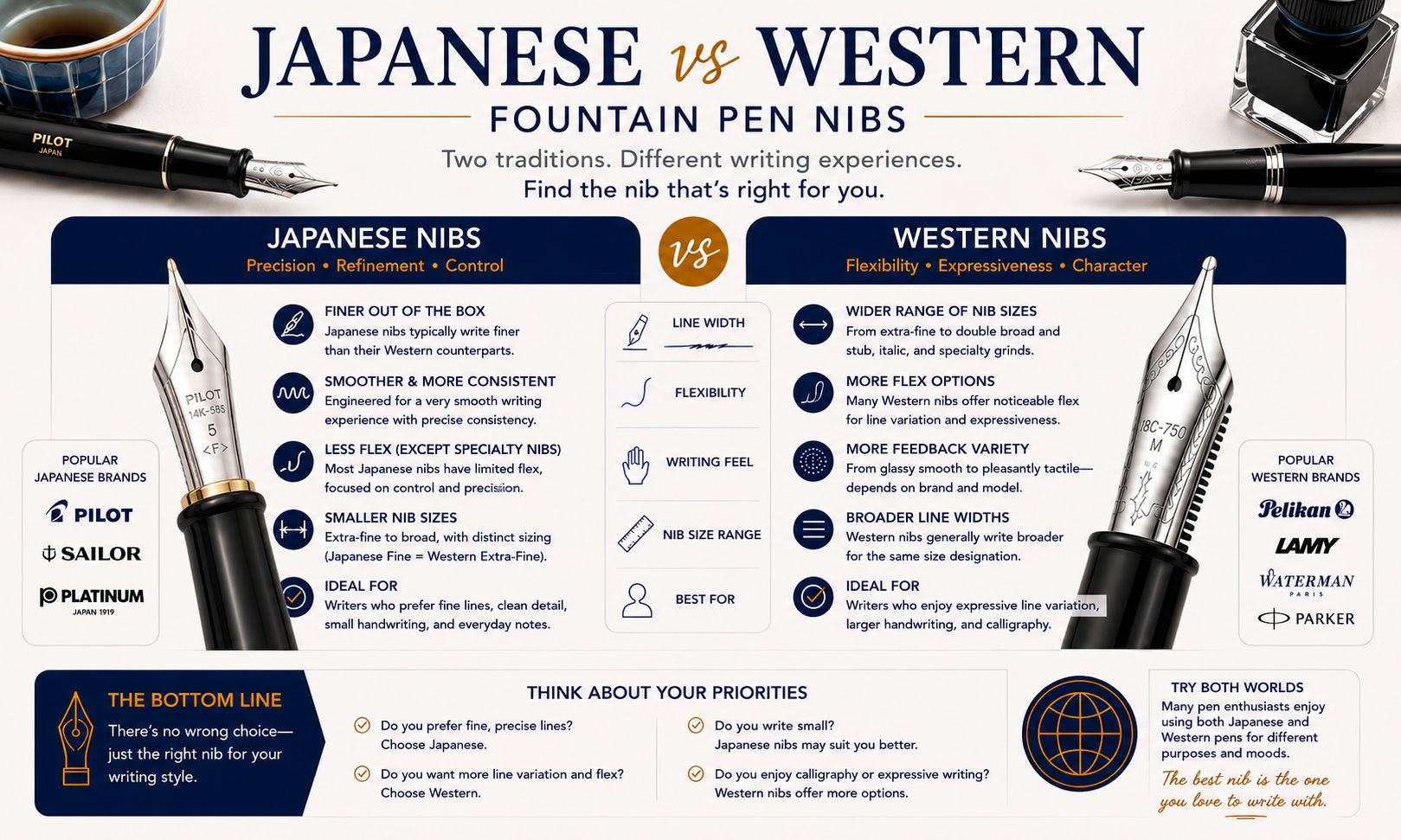
Japanese and Western fountain pen nib sizes often differ significantly, even when labeled with the same size designation. In many cases, Japanese fountain pen nibs write finer and more precise than comparable Western nibs. Understanding these differences can help fountain pen users choose a nib size that better matches their handwriting style, paper choice, and writing preferences.
Many fountain pen users are surprised when a Japanese medium nib writes similarly to a Western fine nib. This difference is one of the most important things to understand when buying fountain pens from different regions.
Why Japanese and Western Nib Sizes Differ
Japanese fountain pen manufacturers traditionally design nibs for smaller handwriting and more precise character-based writing systems. As a result, Japanese nibs are often ground finer than Western nibs.
Western fountain pen brands frequently emphasize smoother, wetter writing and broader line widths suited for cursive and larger handwriting styles.
General Japanese vs Western Nib Size Comparison
While exact sizing varies between brands and nib tuning, many fountain pen users use the following general comparison as a guideline:
- Japanese Fine: Often similar to a Western Extra Fine
- Japanese Medium: Often similar to a Western Fine
- Japanese Broad: Often similar to a Western Medium
These are only general guidelines because actual nib width can vary by manufacturer, ink, and paper.
Japanese Fountain Pen Brands
Japanese fountain pen brands are known for precision nibs, finer line widths, and detailed writing performance.
Popular Japanese fountain pen brands include:
Explore our collection of Japanese pens.
Western Fountain Pen Brands
Western fountain pen brands often produce smoother, wetter nibs with broader writing characteristics.
Popular Western fountain pen brands include:
Which Nib Style Is Better?
Neither Japanese nor Western nibs are objectively better. The ideal nib depends on your handwriting style, preferred paper, and writing goals.
Japanese vs Western Fountain Pen Nibs
| Japanese Fountain Pen Nibs | Western Fountain Pen Nibs |
|---|---|
| Better for small handwriting | Better for larger handwriting styles |
| Excellent for detailed note-taking | Excellent for expressive writing |
| Often performs better on cheap paper | Shows off shading and sheen more easily |
| Produces finer, more precise lines | Provides smoother and wetter ink flow |
| Usually dries faster because less ink is used | Often creates broader, more saturated writing |
How Nib Size Affects Ink Dry Time
Finer nibs generally place less ink on the paper, which can reduce smudging and improve dry times. Broader nibs usually produce more ink saturation and may dry more slowly.
Japanese fine nibs are especially popular among left-handed writers and office users because of their cleaner writing performance.
Read:
How Paper Affects Japanese and Western Nibs
Paper quality can change how fountain pen nibs feel and perform.
Broader Western nibs often show more sheen, shading, and ink saturation on fountain pen friendly paper. Japanese fine nibs may perform better on ordinary office paper because they use less ink.
Learn more in our guide to best quality fountain pen paper.
Choosing the Right Nib Size for Beginners
Many beginners choose medium nibs expecting moderate line widths, but Japanese medium nibs often feel finer than expected compared to Western brands.
If you prefer smoother, wetter writing, Western medium nibs may feel more comfortable. If you want precision and cleaner lines, Japanese fine or medium nibs are often excellent choices.
How This Differs From General Nib Size Guides
This article focuses specifically on regional differences between Japanese and Western fountain pen nib sizing.
For broader nib education and sizing breakdowns, visit:
- Fountain Pen Nib Tipping Sizes
- Fountain Pen Nib Sizes Explained
- How to Choose the Right Nib Size for Fountain Pens
Japanese vs Western Nibs for Everyday Writing
Many users prefer Japanese nibs for note-taking, planners, and work writing because of their precision and cleaner lines. Western nibs are often favored for journaling, expressive writing, and showcasing fountain pen ink properties.
The best choice ultimately depends on your handwriting size, preferred paper, and writing style.
Related Fountain Pen Guides
Visit our Fountain Pen Expert Advice Hub for more fountain pen beginner guides, nib education, and writing tips.
- How to Choose a Fountain Pen
- Fountain Pen Nib Sizes Explained
- How to Write With a Fountain Pen
- Best Fast-Drying Fountain Pen Inks
- Best Fountain Pen Paper
Frequently Asked Questions
Are Japanese fountain pen nibs finer than Western nibs?
Yes, Japanese fountain pen nibs are generally finer and more precise than comparable Western nib sizes.
Is a Japanese medium nib the same as a Western medium nib?
No, a Japanese medium nib often writes closer to a Western fine nib depending on the brand and tuning.
Why are Japanese fountain pen nibs finer?
Japanese nibs are traditionally designed for smaller, more detailed handwriting and character-based writing systems.
Which fountain pen nib is better for beginners?
The best nib depends on writing preference. Japanese nibs offer precision while Western nibs often provide smoother, wetter writing.