




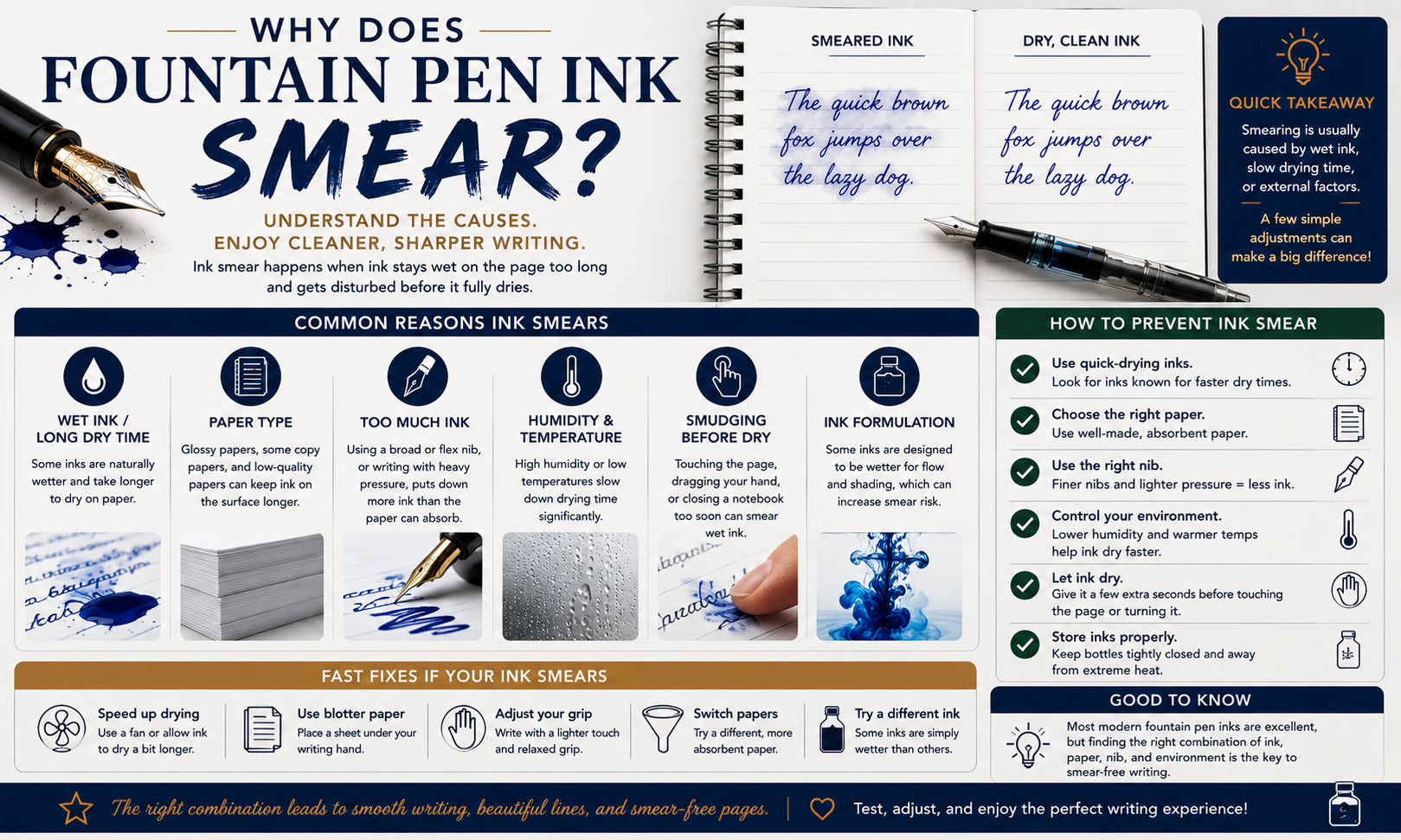
Fountain pen ink smears when the ink has not fully dried, sits on the paper surface too long, or is disturbed by your hand, moisture, or the wrong paper and ink combination. Smearing is common with wet inks, broad nibs, coated paper, and left-handed writing styles, but it can usually be reduced with the right ink, nib, and paper choices.
If your liquid ink for fountain pen ink keeps smudging, understanding dry time, paper absorbency, and ink flow can help you create cleaner, more reliable writing.
Common Reasons Fountain Pen Ink Smears
- The ink has not dried completely
- The fountain pen writes too wet
- The nib is too broad for the paper
- The paper is very smooth or coated
- The ink is heavily saturated, sheening, or slow drying
- Your hand passes over fresh writing
- Moisture or oils from your hand disturb the ink
Ink Dry Time Is the Main Cause of Smearing
The most common reason fountain pen ink smears is simple: the ink is still wet. Fountain pen ink is liquid-based and often takes longer to dry than ballpoint ink, especially on smooth fountain pen friendly paper.
Read our guide to best fast-drying fountain pen inks for ink options that help reduce smudging.
Wet Fountain Pen Inks Smear More Easily
Wet fountain pen inks place more ink on the page, which can create smoother writing, richer color, and better shading. However, more ink also means longer dry times and a greater chance of smearing.
Learn more in our guide to wet vs dry fountain pen inks.
Nib Size Affects Smearing
Broad, stub, and wet medium nibs usually place more ink on the page than fine or extra fine nibs. This can make the writing look darker and more expressive, but it may also increase smearing.
| Nib Size | Smearing Risk | Best Use |
|---|---|---|
| Extra Fine | Lowest | Fast notes, small handwriting, office paper |
| Fine | Low | Everyday writing and note-taking |
| Medium | Moderate | Smooth daily writing and journaling |
| Broad / Stub | Highest | Signatures, expressive writing, ink effects |
Read our guide to fountain pen nib sizes.
Paper Can Cause Fountain Pen Ink to Smear
Smooth fountain pen paper helps prevent feathering and bleed-through, but it can also make ink dry more slowly because the ink stays on the surface longer. Absorbent paper may dry faster but can cause feathering or fuzzy lines.
The goal is to find paper that balances clean lines with practical dry time.
Explore our guides to best paper fountain pen writing and what make fountain pen ink feather?
Sheening and Shimmer Inks May Smear More
Highly saturated sheening inks often take longer to dry because more dye remains on the paper surface. Shimmer inks can also smear if the ink is disturbed before the liquid fully dries.
These inks can look beautiful, but they usually require better paper and more drying time.
Left-Handed Writers and Ink Smearing
Left-handed writers may experience more smearing because the hand can pass over fresh writing before the ink has dried. This is especially common for side writers and overwriters.
Helpful solutions include:
- Use fast-drying fountain pen ink
- Choose fine or extra fine nibs
- Use paper with moderate dry time
- Adjust hand position when possible
- Use blotting paper for longer writing sessions
Read our guide to best fountain pens for left-handed writers.
How to Prevent Fountain Pen Ink Smearing
| Problem | Solution |
|---|---|
| Ink dries too slowly | Use a fast-drying ink |
| Pen writes too wet | Try a drier ink or finer nib |
| Paper is too coated | Use paper with more practical dry time |
| Broad nib smears | Switch to fine or medium nib for daily writing |
| Left hand crosses fresh ink | Use fast-drying ink and blotting paper |
Best Fountain Pen Inks to Reduce Smearing
Fast-drying and controlled-flow inks are usually the best choices for reducing smearing. Blue, blue-black, and black inks are often the most practical for work, school, and everyday writing.
Related guides:
- Best Fast-Drying Fountain Pen Inks
- Best Fountain Pen Ink for Inexpensive Paper
- Best Blue-Black Fountain Pen Inks
Is Smearing the Same as Feathering?
No. Smearing and feathering are different fountain pen ink problems.
- Smearing: Ink moves or smudges after writing because it has not fully dried.
- Feathering: Ink spreads into paper fibers and creates fuzzy lines.
Smearing is usually related to dry time, while feathering is usually related to paper absorbency and ink spread.
Related Fountain Pen Ink Guides
- Premium Fountain Pen Ink
- Best Fast-Drying Fountain Pen Inks
- Wet vs Dry Fountain Pen Inks
- Why Does Fountain Pen Ink Feather?
- Best Fountain Pen Paper
- Best Fountain Pens for Left-Handed Writers
Frequently Asked Questions
Why does fountain pen ink smear?
Fountain pen ink smears when it has not fully dried or when too much ink sits on the paper surface. Wet inks, broad nibs, coated paper, and hand contact can all increase smearing.
How do you stop fountain pen ink from smearing?
Use faster-drying ink, choose a fine or extra fine nib, avoid overly wet pens, use paper with practical dry time, and allow ink to dry before touching it.
Do wet fountain pen inks smear more?
Yes, wet fountain pen inks often smear more because they place more ink on the page and usually require longer dry times.
What nib size helps prevent smearing?
Fine and extra fine nibs help reduce smearing because they place less ink on the paper and usually dry faster than broad nibs.
Is fountain pen ink smearing worse for left-handed writers?
It can be. Left-handed writers may pass their hand over fresh ink before it dries, so fast-drying inks and finer nibs are often helpful.