




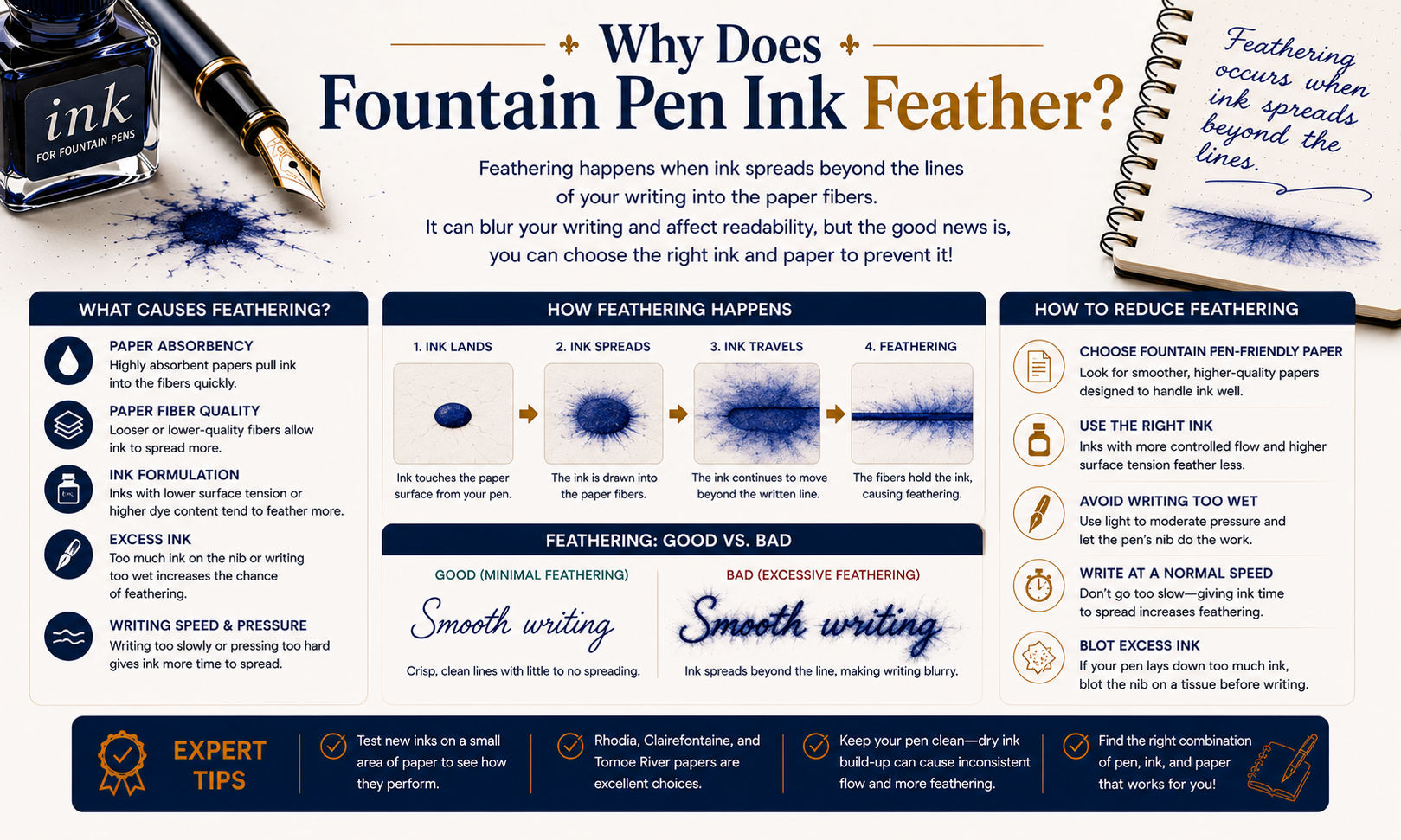
Fountain pen ink feathering happens when liquid ink spreads into the paper fibers, creating fuzzy, uneven, or blurry lines around your handwriting. Feathering is one of the most common fountain pen writing issues and is usually caused by paper quality, ink properties, nib size, or excessive ink flow.
Understanding why fountain pen ink feathers can help you improve writing quality, reduce bleed-through, and create cleaner, sharper handwriting.
What Is Fountain Pen Ink Feathering?
Feathering occurs when fountain pen ink spreads outward after touching the paper instead of staying contained within the written line. This can make handwriting appear fuzzy, messy, or less precise.
Feathering is especially noticeable with wet fountain pens, highly absorbent paper, and heavily saturated inks.
What Causes Fountain Pen Ink Feathering?
Poor Paper Quality
The most common cause of fountain pen feathering is absorbent or low-quality paper. Cheap paper often allows liquid ink to spread through the paper fibers instead of remaining controlled on the surface.
Fountain pen friendly paper is specifically designed to reduce feathering and improve ink performance.
Read our guide to best fountain pen paper for paper recommendations.
Wet Fountain Pen Nibs
Some fountain pens deliver more ink onto the page than others. Wet nibs place heavier amounts of ink on the paper, increasing the likelihood of feathering, especially on poor paper.
Broader nibs also tend to feather more because they deposit more liquid ink.
Learn more in our guide to fountain pen nib sizes explained.
Highly Saturated Fountain Pen Ink
Some fountain pen inks are formulated with heavy saturation, lubrication, sheen, or shimmer properties. These inks may feather more easily on absorbent paper.
Highly saturated inks can look beautiful on fountain pen friendly paper but may spread on lower-quality paper.
Cheap or Absorbent Paper
Standard office paper, inexpensive notebooks, and highly porous paper often absorb fountain pen ink too quickly, causing feathering and bleed-through.
Even excellent fountain pens may perform poorly on low-quality paper.
How to Prevent Fountain Pen Ink Feathering
Use Fountain Pen Friendly Paper
The easiest way to reduce feathering is to use paper designed for fountain pens.
Popular fountain pen papers include:
- Tomoe River paper
- Rhodia paper
- Clairefontaine paper
- Midori paper
Use a Finer Nib
Fine and extra fine nibs usually feather less because they place less ink onto the page.
If you regularly write on office paper or inexpensive notebooks, finer nibs are often more practical.
Choose a Drier Fountain Pen Ink
Some fountain pen inks behave better on lower-quality paper because they flow more conservatively and dry faster.
For practical daily writing, visit our guide to best fountain pen inks for everyday use.
Avoid Overly Wet Pens on Cheap Paper
Very wet fountain pens paired with broad nibs and saturated inks may produce feathering even on moderately decent paper.
Feathering vs Bleed-Through
Feathering and bleed-through are different fountain pen paper problems.
- Feathering: Ink spreads outward creating fuzzy lines
- Bleed-through: Ink soaks through the paper to the opposite side
Both problems are commonly caused by absorbent paper and wet writing combinations.
Do Sheening and Shimmer Inks Feather More?
Some sheen and shimmer inks may feather more easily because they are often highly saturated and place more material onto the page surface.
Learn more in our guides to:
Does Waterproof Fountain Pen Ink Feather?
Some waterproof or pigment-based fountain pen inks may feather differently depending on the paper and formulation. Certain pigment inks remain very controlled, while some permanent inks can spread more on absorbent paper.
Learn more in our waterproof fountain pen ink guide.
How Paper Affects Ink Performance
Paper texture, coating, thickness, and absorbency all influence how fountain pen ink behaves.
Smooth, coated paper keeps ink near the surface and creates cleaner lines, while rough absorbent paper pulls ink into the fibers.
Should Beginners Worry About Feathering?
Feathering is common for beginners because many new fountain pen users start with ordinary office paper or highly wet inks. Fortunately, changing paper or using a finer nib often solves the problem quickly.
If you are new to fountain pens, our guide on how to write with a fountain pen can help improve overall writing performance.
Related Fountain Pen Ink Guides
Visit our Fountain Pen Ink Guides Hub for more guides on fountain pen paper, ink behavior, and writing performance.
- Best Fountain Pen Paper
- Best Fountain Pen Inks for Everyday Use
- What Is Fountain Pen Ink Shading?
- Dye vs Pigment Fountain Pen Ink
- Waterproof Fountain Pen Ink Guide
- highest rated fountain pen inks
Frequently Asked Questions
Why does fountain pen ink feather?
Fountain pen ink feathers when ink spreads into absorbent paper fibers instead of remaining controlled on the paper surface.
How do you stop fountain pen ink from feathering?
Using fountain pen friendly paper, finer nibs, and less saturated inks can help reduce feathering.
Does cheap paper cause fountain pen feathering?
Yes, absorbent and low-quality paper is one of the most common causes of fountain pen ink feathering.
Do broad fountain pen nibs feather more?
Yes, broad fountain pen nibs usually feather more because they place larger amounts of liquid ink on the paper.