




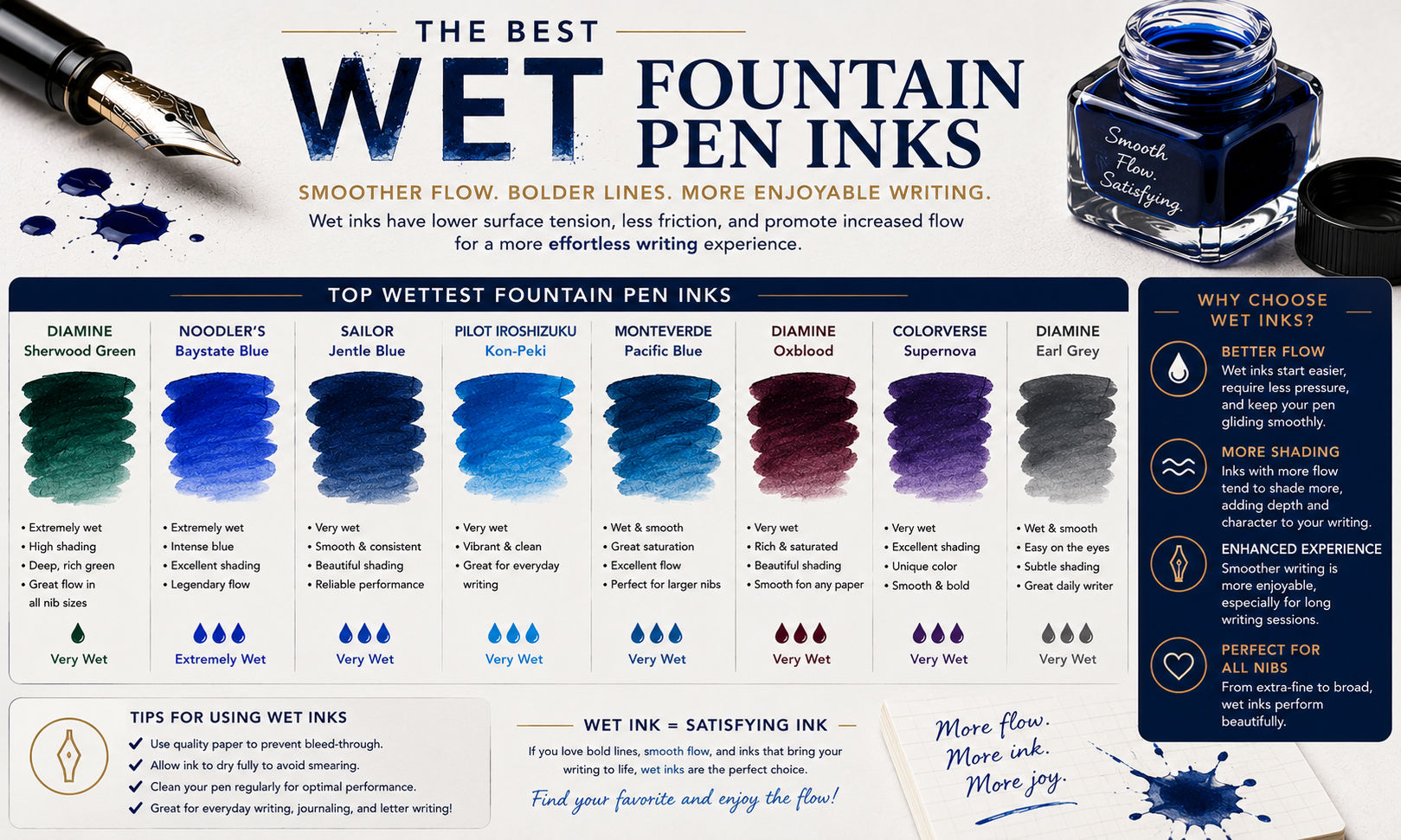
One of the most common terms you'll hear in the fountain pen community is that an ink writes "wet" or "dry." However, wet and dry fountain pen inks don't refer to how much liquid is inside the bottle. Instead, they describe how the ink behaves when it flows through a fountain pen and onto paper. Understanding the difference between wet and dry fountain pen inks can help you choose inks that match your writing style, paper, nib size, and fountain pen.
Whether you're trying to reduce feathering on cheap paper, improve dry times, increase shading, or create smoother writing, understanding ink wetness is an important part of choosing the right fountain pen ink.
What Is a Wet Fountain Pen Ink?
A wet fountain pen ink generally flows more freely through the feed and nib, placing more ink on the page during writing. Wet inks often feel smoother and more lubricated, especially when used in finer nib fountain pens.
Wet inks are often known for:
- Smoother writing feel
- Greater ink flow
- More visible shading
- More noticeable sheen
- Darker lines
- Longer dry times
Popular examples of wetter fountain pen inks often include Pilot Iroshizuku inks, Sailor inks, and many Monteverde fountain pen inks.
What Is a Dry Fountain Pen Ink?
A dry fountain pen ink typically delivers less ink to the page during writing. Dry inks often provide faster dry times, better performance on inexpensive paper, and reduced feathering.
Dry inks are often known for:
- Controlled ink flow
- Faster dry times
- Reduced feathering
- Better performance on cheap paper
- Cleaner lines
- More writing feedback
Pelikan 4001 inks are often cited as classic examples of drier fountain pen inks.
Wet vs Dry Fountain Pen Ink Comparison
| Characteristic | Wet Ink | Dry Ink |
|---|---|---|
| Ink Flow | Higher | Lower |
| Writing Feel | Smoother | More Feedback |
| Dry Time | Slower | Faster |
| Shading | More Visible | Less Visible |
| Sheen | More Visible | Less Visible |
| Cheap Paper Performance | Can Feather More | Usually Better |
| Line Width | Often Appears Broader | Often Appears Finer |
Are Wet Fountain Pen Inks Better?
Not necessarily. Wet fountain pen inks are often preferred by writers who enjoy smooth writing, rich color saturation, shading, and sheen. However, wet inks may also increase feathering and bleed-through on lower-quality paper.
If you primarily write on premium fountain pen paper, a wetter ink may provide a more enjoyable writing experience.
Are Dry Fountain Pen Inks Better?
Dry fountain pen inks can be advantageous for users who write on office paper, school notebooks, and other absorbent papers. Faster dry times can also reduce smudging and improve usability for left-handed writers.
Many users find dry inks easier to manage for practical everyday writing.
Which Is Better for Cheap Paper?
Dry fountain pen inks are often better suited for inexpensive paper because they place less ink on the page, reducing feathering and bleed-through.
Learn more in our guide to best fountain pen ink for cheap paper.
Which Is Better for Left-Handed Writers?
Many left-handed fountain pen users prefer drier inks because they typically dry faster and reduce smudging.
Read our guide to best fast-drying fountain pen inks.
Which Is Better for Shading and Sheen?
Wet fountain pen inks generally show more shading and sheen because more ink is deposited on the page. Broad nibs and fountain pen friendly paper can enhance these effects even further.
Learn more:
How Nib Size Affects Ink Wetness
Nib size can significantly influence how wet or dry a fountain pen feels. Broad nibs generally place more ink on the page than fine nibs, which can make even a dry ink feel wetter.
Likewise, fine nibs can help control wetter inks and improve paper performance.
Related guides:
- Fine vs Medium Fountain Pen Nibs
- Best Fountain Pen Nib Size for Beginners
- Fountain Pen Nib Sizes Explained
Can You Make a Fountain Pen Write Wetter or Drier?
Yes. Ink selection is one of the easiest ways to change how a fountain pen writes.
You can often make a pen write wetter by:
- Using a wetter ink
- Using a broader nib
- Using smoother fountain pen paper
You can often make a pen write drier by:
- Using a drier ink
- Using a finer nib
- Writing on more absorbent paper
How to Choose Between Wet and Dry Fountain Pen Inks
| If You Want... | Choose... |
|---|---|
| Smoother writing | Wet Ink |
| More shading | Wet Ink |
| More sheen | Wet Ink |
| Faster dry times | Dry Ink |
| Less feathering | Dry Ink |
| Better cheap paper performance | Dry Ink |
Related Fountain Pen Ink Guides
- Best Fast-Drying Fountain Pen Inks
- Best Fountain Pen Ink for Cheap Paper
- Why Does Fountain Pen Ink Feather?
- What Is Fountain Pen Ink Shading?
- What Is Fountain Pen Ink Sheen?
- Dye vs Pigment Fountain Pen Ink
Frequently Asked Questions
What is a wet fountain pen ink?
A wet fountain pen ink flows more freely through the nib and feed, placing more ink on the page and often creating a smoother writing experience.
What is a dry fountain pen ink?
A dry fountain pen ink delivers less ink to the page, often resulting in faster dry times, less feathering, and improved performance on inexpensive paper.
Are wet fountain pen inks better?
Wet fountain pen inks are not necessarily better, but many writers prefer them for smoother writing, richer color, greater shading, and more visible sheen.
Are dry fountain pen inks better for cheap paper?
Yes, dry fountain pen inks often perform better on cheap paper because they reduce feathering, bleed-through, and excessive ink spread.
Which fountain pen inks are considered wet?
Many Pilot Iroshizuku, Sailor, and Monteverde inks are often considered relatively wet-writing fountain pen inks.
Which fountain pen inks are considered dry?
Pelikan 4001 inks and some iron gall fountain pen inks are often considered drier-writing fountain pen inks.